// WEARABLE · 2019
GUIBE
Helping visually impaired users be self-reliant when navigating cities.
- PCB design
- Bluetooth LE
- Swift / iOS
- Wearables
- CAD
- Haptics
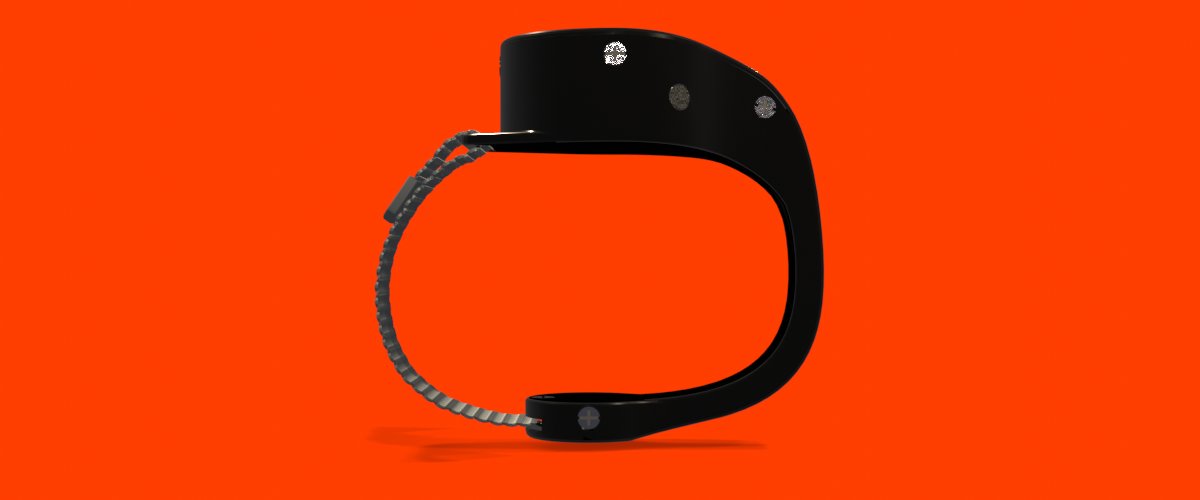
scroll to rotate · drag to scrub
Overview
As my main second-year project I developed a wearable device that uses haptics to guide a visually impaired user through a city environment. It was a group project — I took the CTO role, responsible for the electronics back-end, circuit design, and the iOS app that interfaced with the bracelet.
Research
For three months we researched and conducted interviews. We discovered that the most dangerous part of a user’s day was the journey itself — particularly when navigating alone. To address this we eliminated voice instructions entirely and used discreet haptics to send turn-by-turn directions to the user’s wrist.
The build
The bracelet interfaced with an iPhone app — we chose Apple because it offers far more accessibility features than any other platform, and the visually impaired market predominantly uses Apple products. To bypass the need for MFi certification, I designed a custom circuit that amplifies analogue sound signals, then connected a small Bluetooth receiver to the phone just like a pair of headphones.